Introduction
If your child struggles with handwriting, can’t sit still in class, melts down when wearing certain clothes, or seems “behind” with everyday tasks like buttoning a shirt or holding a spoon, you may have been told to “see an occupational therapist.” But what exactly does an occupational therapist do, and how do you know if your child actually needs occupational therapy?
This guide answers the most common questions parents in Noida, Ghaziabad, and the wider NCR region ask before booking their first OT session — what occupational therapy is, who it helps, what a session looks like, and how to choose the right occupational therapist near you. Whether you’re researching pediatric occupational therapy for the first time or comparing clinics for a second opinion, this article will help you make an informed decision for your child’s development.
What Is an Occupational Therapist?
An occupational therapist (often shortened to “OT”) is a licensed allied-health professional trained to help people of all ages perform the daily activities — or “occupations” — that matter most to them. For a child, those occupations aren’t a job. They are the everyday things kids are supposed to do: playing, dressing, eating, writing, paying attention in class, making friends, and managing their own emotions.
When any of these everyday tasks become unusually difficult, an occupational therapist steps in. Through structured, play-based therapy, the OT identifies why a child is struggling — whether it’s a sensory processing difference, weak fine-motor control, poor postural stability, attention regulation, or a combination — and builds a personalized plan to help them catch up and thrive.
In India, a qualified occupational therapist holds a Bachelor’s (BOT) or Master’s (MOT) degree in Occupational Therapy and is registered with the All India Occupational Therapists’ Association (AIOTA). At Percept Rehabilitation Center, every occupational therapist on the team holds these credentials and undergoes ongoing pediatric specialization.
What Is Occupational Therapy (OT), Really?
Occupational therapy is one of the most misunderstood therapies in India. Parents often assume “occupational” means “career,” and worry that OT is only for adults recovering from injury or stroke. In reality, occupational therapy spans the entire lifespan, but the largest specialty in pediatric clinics is helping children build the foundational skills they need for school, home, and social life.
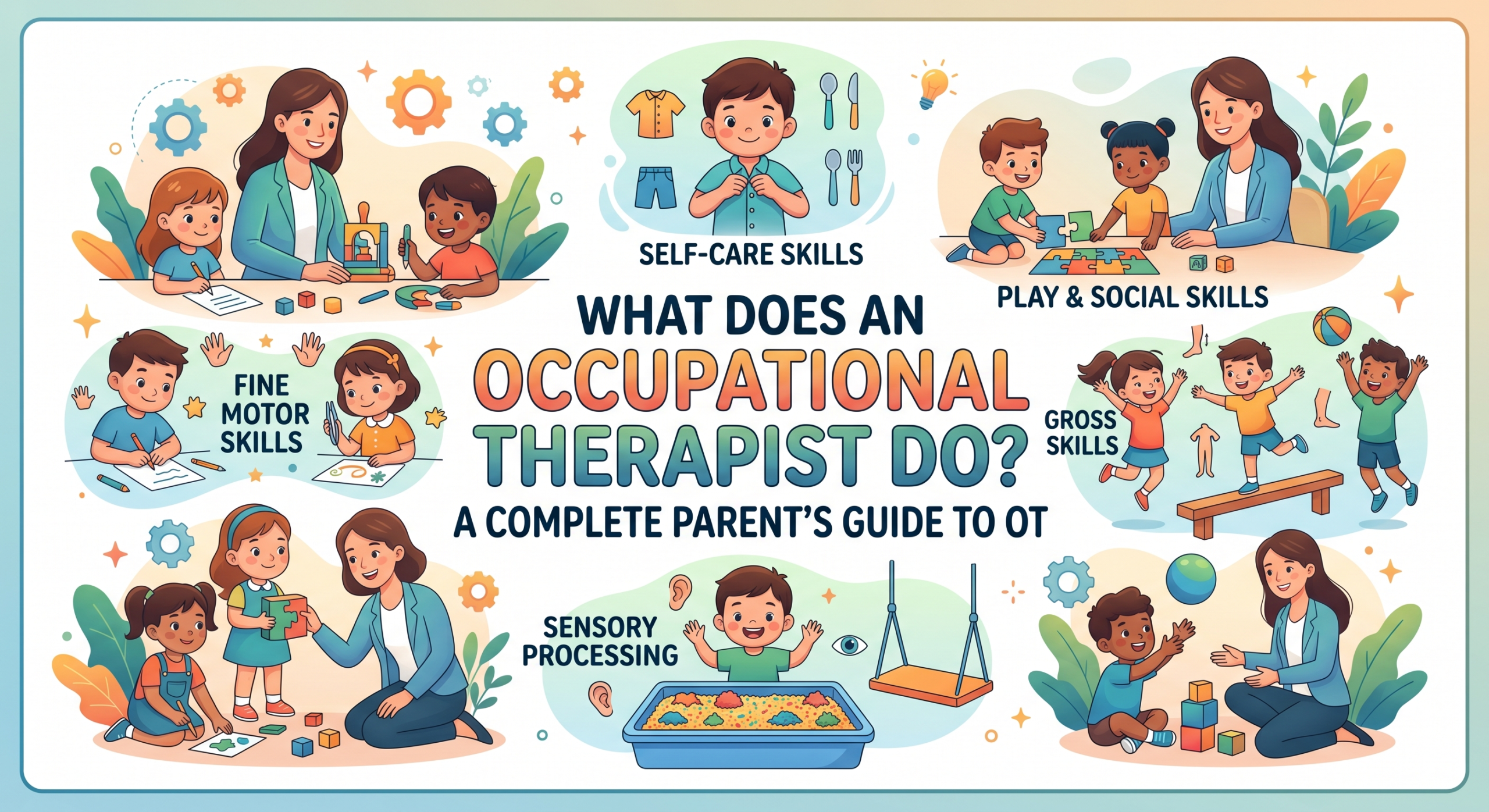
A typical occupational therapy program targets one or more of the following developmental domains:
- Fine motor skills — pencil grip, handwriting, cutting with scissors, buttoning, tying laces.
- Gross motor skills — balance, coordination, core strength, riding a bicycle, climbing stairs.
- Sensory integration — how the brain organizes input from sight, sound, touch, movement, and body awareness.
- Visual-motor and visual-perceptual skills — copying from the board, completing puzzles, tracking lines while reading.
- Activities of daily living (ADLs) — dressing, brushing, bathing, eating with utensils, toileting independently.
- Self-regulation and attention — staying focused, managing big emotions, coping with frustration.
- Play and social skills — turn-taking, pretend play, joining peers, following game rules.
Each of these areas becomes a measurable goal in your child’s OT plan, with progress reviewed every 8–12 weeks.
Who Needs to See an Occupational Therapist?
Not every clumsy child needs therapy. But occupational therapy is strongly recommended when day-to-day functioning is being affected. Some of the most common reasons families in Noida and the surrounding NCR seek out an occupational therapist near them include:
- Autism Spectrum Disorder (ASD) — to support sensory regulation, play skills, transitions, and daily routines.
- Attention Deficit Hyperactivity Disorder (ADHD) — to build attention, impulse control, and task completion.
- Developmental delay or “late milestones” — children who are walking, talking, or self-feeding later than expected.
- Sensory Processing Disorder (SPD) — children who are over- or under-responsive to sound, touch, taste, movement, or light.
- Learning disabilities including dyslexia, dysgraphia, and dyscalculia — particularly for handwriting and classroom endurance.
- Cerebral palsy and other neuromotor conditions — to maximize independence and motor function.
- Down syndrome and other genetic conditions — to build strength, coordination, and self-care skills.
- Handwriting difficulties — slow, illegible, or painful writing in otherwise bright kids.
- Feeding difficulties — picky eating that goes beyond preference, oral-motor delays, or texture aversion.
- Anxiety, big emotions, and behavioural challenges — when sensory or regulation issues are at the root.
If you’ve ever said, “everyone tells me he’ll grow out of it, but something isn’t right” — trust that instinct. Early intervention with a skilled occupational therapist consistently produces stronger outcomes than waiting.
Pediatric Occupational Therapy: How It’s Different from Adult OT
Pediatric occupational therapy looks nothing like adult OT — and that’s by design. A child won’t sit through dry exercises, so a paediatric occupational therapist disguises every goal inside play.
In a single 45-minute session at Percept, your child might:
- Swing on a platform swing (vestibular and core input).
- Crawl through a tunnel and climb a ladder (motor planning and proprioception).
- Pick up tiny beads with tweezers to “feed the dragon” (fine-motor precision and bilateral coordination).
- Trace shaving foam letters on a vertical surface (pre-writing and shoulder stability).
- Play a turn-taking board game while regulating frustration (executive function and social skills).
To the child, it’s an hour of play. To the occupational therapist, every activity is a calibrated dose of sensory, motor, and cognitive input chosen to move a specific developmental goal forward.
What Happens at Your Child’s First OT Appointment?
- Detailed parent interview (30–45 minutes). The occupational therapist will ask about pregnancy, birth, milestones, school reports, medical history, sensory preferences, and your top three concerns.
- Standardized and clinical assessments. Depending on your child’s age, the OT may use tools such as the Sensory Profile-2, BOT-2, Beery VMI, or DASH for handwriting.
- Goal-setting conversation. You and the therapist agree on 3–5 measurable goals.
- Therapy plan and home program. You’ll leave with a written plan and recommended session frequency.
Benefits of Working with a Qualified Occupational Therapist
- Within 4–6 weeks: the child is calmer, sleeps better, and has fewer meltdowns.
- Within 3–6 months: improvement in handwriting, independence, and focus.
- Within 6–12 months: better social participation and confidence.
How to Find the Right Occupational Therapist Near You
- Confirm credentials (BOT/MOT + AIOTA).
- Check pediatric specialization.
- Tour the sensory gym.
- Look for a multidisciplinary team.
- Ask about parent involvement.
- Read recent reviews.
Looking for Occupational Therapy Near Noida? Here’s Why Families Choose Percept Rehabilitation Center
- Pediatric-only focus.
- Personalized treatment plans.
- Multidisciplinary team.
- Evidence-based approach.
- Parent partnership.
- Easy access from Noida, Indirapuram, Vaishali, Kaushambi & Ghaziabad.
Frequently Asked Questions about Occupational Therapy
Q1. What is the difference between an occupational therapist and a physiotherapist?
A physiotherapist focuses on physical recovery. An occupational therapist focuses on daily life skills and function.
Q2. At what age can pediatric occupational therapy start?
OT can start as early as 6–9 months. Most referrals occur between ages 2 and 8.
Q3. How often does my child need OT sessions?
Typically 2–3 sessions per week.
Q4. Will insurance cover occupational therapy in India?
Some insurers reimburse OT when prescribed. Check with your provider.
Q5. Is OT the same as special education or tuition?
No. OT builds foundational skills; education focuses on academics.
Q6. Do I need a doctor’s referral?
Not always. Self-referrals are accepted in most private clinics.
Take the Next Step
Choosing the right occupational therapist is one of the most important decisions you’ll make for your child’s development.
Book a free 20-minute screening at Percept Rehabilitation Center.
→ Book Your Free Screening
→ Visit: www.perceptrehabilitation.co.in