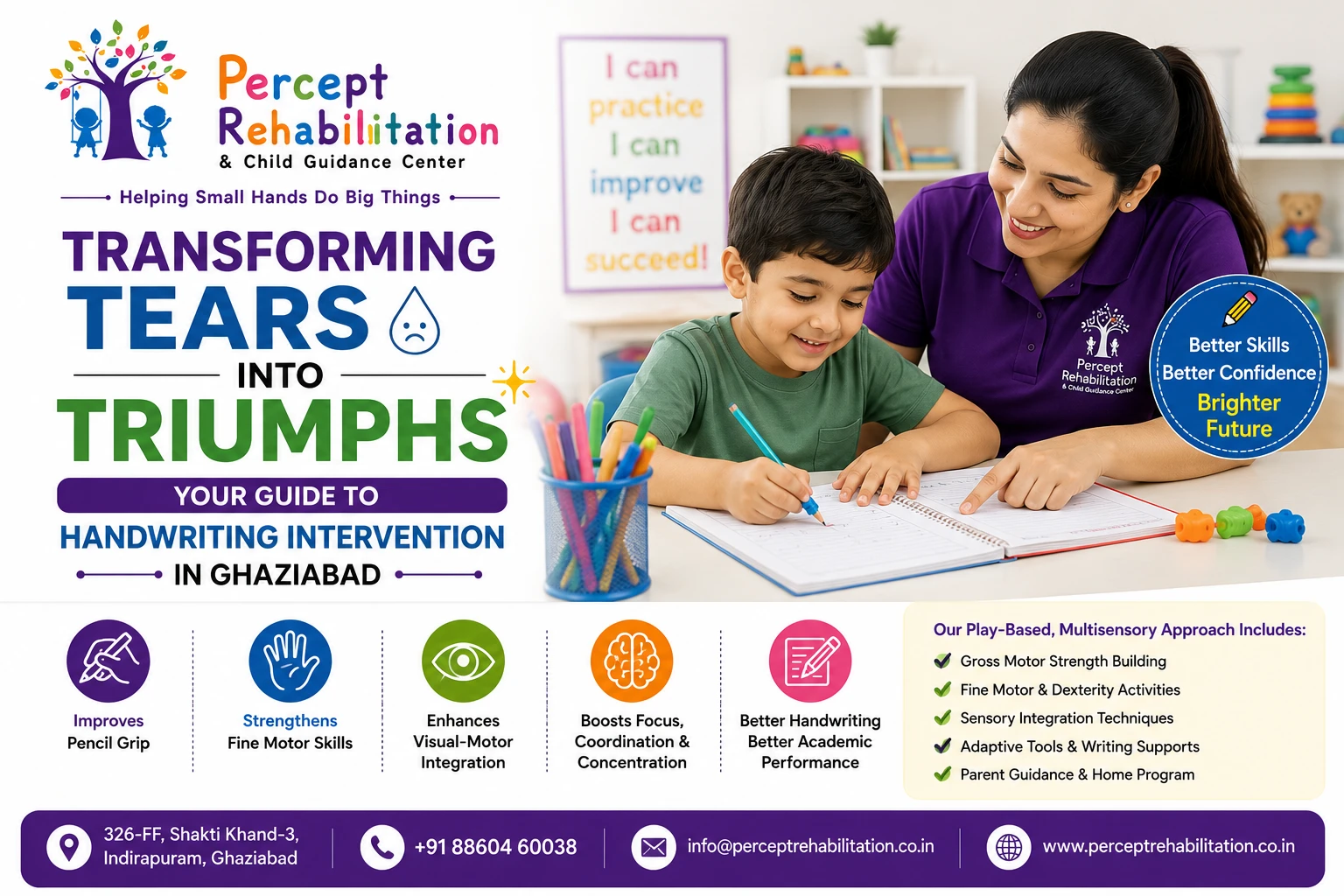
For many children, learning to write is an exciting milestone. But for others, homework time quickly turns into a daily battle of tears, frustration, and erased pages. If your child’s handwriting is illegible, if they complain that their hand hurts after writing just a few sentences, or if they actively avoid drawing and coloring, they are not simply being “lazy.” They might be struggling with underlying motor or cognitive challenges that require professional support.
At Percept Rehabilitation Center in Indirapuram, Ghaziabad, we understand how deeply handwriting struggles can impact a child’s confidence and academic performance. Our specialized handwriting intervention programs are designed to uncover the root cause of these difficulties and equip your child with the physical and cognitive tools they need to write with ease.
This guide will explain why some children struggle with handwriting, the hidden signs to look out for, and how expert occupational therapy can turn stressful homework sessions into successful learning experiences.
The Hidden Complexity of Handwriting
As adults, we write without thinking about it. However, handwriting is actually one of the most complex tasks a child’s brain and body are asked to perform. It requires the seamless coordination of several different systems:
- Fine Motor Control: The precise movement of the small muscles in the fingers and hands.
- Visual-Motor Integration: The ability of the eyes to guide the hands (hand-eye coordination).
- Core and Shoulder Strength: A strong core and stable shoulders are necessary to hold the arm and wrist steady.
- Proprioception: The body’s internal sense of pressure, which tells the child how hard to grip the pencil and how hard to press on the paper.
If just one of these systems is delayed or out of sync, handwriting becomes a frustrating, exhausting chore.
The Statistics on Handwriting Struggles
Parents often feel alone when their child struggles in school, but handwriting difficulties are incredibly common.
- Prevalence: Research indicates that between 10% and 30% of elementary school children experience significant difficulty with handwriting.
- Impact on Grades: Poor handwriting is directly linked to lower academic scores, even when the child understands the subject matter perfectly. Teachers often struggle to grade what they cannot read.
- Dysgraphia: Many children with severe writing difficulties have an underlying neurological condition called Dysgraphia, which affects roughly 5% to 20% of all students.
- Co-occurring Conditions: Handwriting struggles frequently overlap with Attention Deficit Hyperactivity Disorder (ADHD), Autism Spectrum Disorder (ASD), and Sensory Processing Disorder (SPD).
Signs Your Child Needs Handwriting Intervention
How do you know the difference between typical messy handwriting and a mechanical issue that needs therapy? Look out for these common red flags:
- An Awkward Grip: Holding the pencil with a tightly clenched fist, wrapping the thumb over the fingers, or holding it far too close to the paper.
- Physical Pain: Frequent complaints that their hand, wrist, or arm feels tired or sore after writing for a short time.
- Pressure Issues: Pressing so hard that the pencil frequently snaps or tears the paper, or pressing so lightly that the words are barely visible.
- Poor Spacing and Sizing: Writing letters that float above the line, mixing upper and lower case letters randomly, or squishing words completely together with no spaces.
- Avoidance: Refusing to do homework, crying during writing tasks, or verbally expressing that they are “bad at school.”
How Percept’s Handwriting Intervention Works
At Percept Rehabilitation Center, we do not believe in simply forcing a child to trace letters for hours on end. If the underlying muscles are weak, tracing won’t fix the problem! Instead, our highly trained occupational therapists use a play-based, multi-sensory approach to build the necessary foundation for successful writing.
When you seek handwriting intervention in Ghaziabad with our team, here is what your child’s therapy might look like:
1. Building the Foundation (Gross Motor Work)
You cannot have strong fingers without strong shoulders and a strong core. Our therapists often start sessions in the sensory gym, having children navigate obstacle courses, climb, or work on vertical surfaces (like whiteboards or easels) to build upper body strength and stability.
2. Fine Motor and Dexterity Exercises
To improve a child’s pencil grasp, we first strengthen the tiny muscles in their hands. We use fun activities like:
- Hiding small beads inside tough therapy putty for the child to pinch and pull out.
- Using tweezers to pick up and sort small objects.
- Stringing beads and playing with pegboards to develop the essential “pincer grasp” (the coordination of the index finger and thumb).
3. Visual-Motor and Sensory Activities
To help children understand how to form letters and space words, we take a multi-sensory approach. We move away from boring lined paper and instead have children practice forming letters in shaving cream, sand, or finger paint. We also introduce specially adapted tools like pencil grips, weighted pens, or slanted writing boards to provide the exact sensory feedback your child’s nervous system needs.
Why Choose Percept Rehabilitation Center in Ghaziabad?
Choosing the right pediatric therapy center is crucial for your child’s success. At Percept Rehabilitation Center, located in the heart of Indirapuram, we offer unparalleled clinical care wrapped in a warm, welcoming environment.
- Expert Occupational Therapists: Our clinicians are highly trained in identifying the subtle neurological and physical disconnects that cause handwriting failure.
- Thorough Assessments: We start with a comprehensive evaluation that looks at your child’s whole body—not just their hands—to pinpoint exactly where the breakdown is occurring.
- Empowering Parents: We do not just work with your child; we equip you with simple, engaging home activities to continue building their skills outside of the clinic.
- State-of-the-Art Tools: Our facility is fully equipped with the latest therapeutic tools, sensory gyms, and adaptive equipment necessary to make learning to write fun again.
Rewrite Your Child’s Academic Story Today
Do not let messy handwriting chip away at your child’s self-esteem or academic potential. With the right therapeutic intervention, the physical act of writing can become automatic, freeing up your child’s brain to focus on expressing their brilliant thoughts and ideas.
Early intervention is the key to preventing bad habits from becoming permanent. Partner with the leading experts in pediatric occupational therapy and handwriting intervention in Ghaziabad today.
Take the First Step Toward Stress-Free Learning
- Location: 326-FF, Shakti Khand-3, Indirapuram, Ghaziabad
- Phone: +91 88604 60038
- Email: info@perceptrehabilitation.co.in
- Book Online: https://www.perceptrehabilitation.co.in/
Give your child the confidence to leave their mark on the world. Contact Percept Rehabilitation Center today to schedule a comprehensive handwriting assessment.