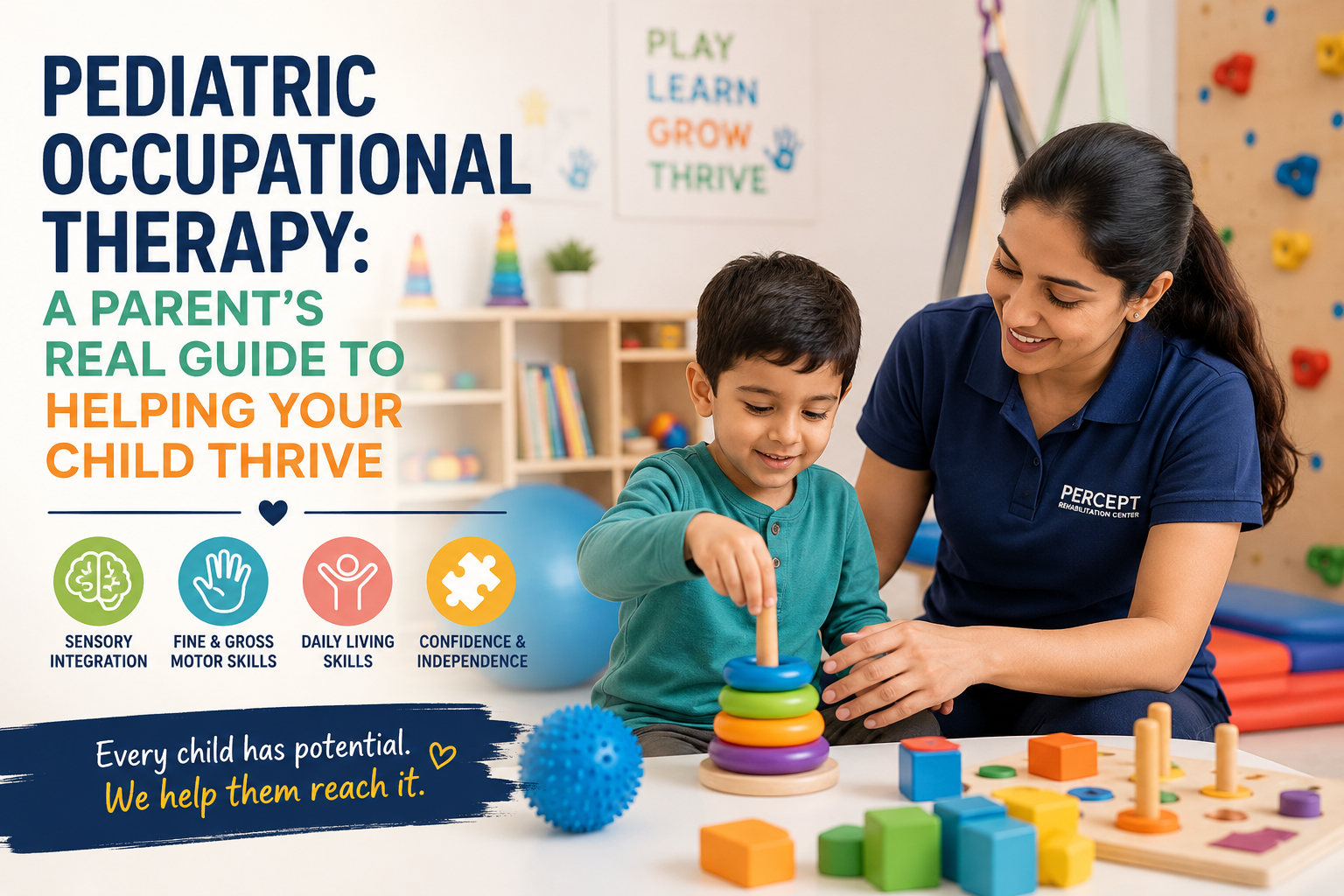
The first time a parent walks into our clinic, there’s almost always the same look on their face. A mix of worry, exhaustion, and quiet hope. They’ve usually spent months — sometimes years — being told things like “he’ll grow out of it” or “every child develops at their own pace.” And yes, that’s often true. But sometimes, it isn’t.
If you’ve found yourself googling “occupational therapist near me” at midnight, or wondering whether your child’s meltdowns over shirt tags are normal, you’re in the right place. This guide is written for parents — not textbooks — and it’ll walk you through what pediatric occupational therapy actually is, when to consider it, and what to expect.
What Is Pediatric Occupational Therapy, Really?
Let’s drop the jargon for a minute. Pediatric occupational therapy (or pediatric OT) is therapy that helps children do the “occupations” of childhood — playing, learning, eating, dressing, making friends, sitting still in class, holding a pencil. When something gets in the way of those everyday things, an occupational therapist steps in.
It’s not just for children with diagnosed conditions. Plenty of kids we see don’t have a label at all. They just struggle — with handwriting, with focus, with handling loud places, with tying shoes long after their classmates have figured it out. Child development therapy isn’t about “fixing” anything. It’s about giving kids the tools their brains and bodies need to keep up with the demands of being a kid.
A good occupational therapist doesn’t just hand out exercises. They watch how your child moves, plays, reacts. Then they build a plan around that specific child — not a one-size-fits-all program.
Signs Your Child Might Benefit From Pediatric OT
Parents often ask, “How do I know if it’s serious enough?” Honestly, you don’t always know. But here are patterns we see often:
- Your child avoids certain textures, sounds, or foods — to the point where mealtimes or getting dressed become daily battles.
- Handwriting is a struggle. Letters are messy, the pencil grip looks awkward, or your child gets tired writing even short paragraphs.
- They’re clumsy. Bumping into things, falling often, struggling with stairs or jungle gyms.
- Big emotions, small triggers. Meltdowns over haircuts, nail clipping, tags on clothes, the seam in socks.
- Trouble with daily routines — buttoning shirts, using a fork, brushing teeth — long past the age peers have mastered them.
- Difficulty paying attention in class or while playing, fidgeting constantly, or seeming to “tune out.”
- Late milestones — sitting, crawling, walking, speaking, all on the slower end.
One sign alone isn’t a red flag. But if a few of these feel uncomfortably familiar, it’s worth a conversation with a professional. Early action almost always means easier progress.
What Actually Happens in a Pediatric OT Session?
Here’s something that surprises most parents: OT looks like play. That’s not because the therapist is being lazy. It’s because play is how children learn. A child swinging, climbing, scooping rice, threading beads, or jumping on a trampoline isn’t just having fun — they’re rewiring how their nervous system processes the world.
A typical session might include:
- Sensory integration therapy — structured activities (swings, weighted blankets, textured surfaces, obstacle courses) that help a child’s brain organize and respond to sensory input. This is huge for kids who are over- or under-sensitive to their environment.
- Fine motor work — beads, scissors, pegs, clay — to build the tiny hand muscles needed for writing, buttoning, and self-care.
- Gross motor activities — balance beams, balls, climbing — to develop core strength and coordination.
- Cognitive and play-based tasks — puzzles, sequencing games, pretend play — to support attention, planning, and problem-solving.
- Family coaching — because what happens in 45 minutes a week matters far less than what happens at home the other 167 hours.
At Percept Rehabilitation Center, we believe parents are the therapy. Sessions are designed so you take real strategies home, not just observations.
Common Conditions Pediatric OT Supports
While we work with many children who simply need a developmental boost, pediatric therapy is especially helpful for:
- Autism Spectrum Disorder— supporting communication, sensory regulation, and daily living skills.
- ADHD — building focus, impulse control, and self-regulation.
- Sensory Processing Disorder— helping children who feel either overwhelmed or under-responsive to their environment.
- Learning Disabilities — strengthening the foundations needed for reading, writing, and classroom success.
- Developmental Coordination Disorder — improving motor planning and physical confidence.
- Cerebral Palsy and other neurological conditions — increasing independence in everyday tasks.
If your child has any of these diagnoses — or you suspect something but don’t have a name for it yet — an occupational therapy assessment is usually the right first step.
How Long Does Therapy Take?
Parents always want a number. The honest answer? It depends. Some children show clear progress in 8–12 weeks. Others need consistent support for a year or more. What matters more than the timeline is whether you’re seeing small, real changes — your child sitting through dinner, finishing homework without tears, making it through a birthday party without a meltdown.
Therapy isn’t linear. There will be weeks where nothing seems to move. Then suddenly, your child does something that floors you. That’s how growth works.
Choosing the Right Pediatric Occupational Therapist
If you’re searching for an occupational therapist near me — whether you’re in Indirapuram, Vaishali, Vasundhara, or looking for occupational therapy near Noida — here’s what to look for:
- Qualified, licensed therapists with specific pediatric training (not just general OT).
- A proper assessment process before any therapy plan is built — beware of clinics that prescribe sessions before evaluating.
- Sensory integration trained therapists if your child has sensory concerns. This is a specialized credential.
- Parental involvement built into the model. If a clinic doesn’t want you watching or asking questions, that’s a red flag.
- A child-friendly space with proper sensory equipment — swings, ball pits, climbing gear. OT can’t happen in a sterile office.
You can learn more about our approach and the conditions we treat — including sensory integration, early intervention, and speech and language therapy.
A Word for the Worried Parent
If you’ve read this far, you care. Deeply. And here’s something that took me years to fully understand: needing therapy doesn’t mean you’ve failed your child, and it doesn’t mean your child is broken. It means you’re paying attention. It means you’re willing to do the harder thing — to show up, ask questions, and get support — instead of waiting and hoping.
Some of the brightest, funniest, kindest kids we work with came to us because their parents trusted their gut. That instinct telling you something’s not quite right — listen to it.
Ready to Take the Next Step?
If you’d like to talk to someone, no pressure, no commitment — just a real conversation about your child — we’re here. You can book an occupational therapist appointment directly through our website, or call us at +91 88604 60038.
We’re located at 326-FF, Shakti Khand 3, Indirapuram, Ghaziabad, and we work with families from across the NCR — including Noida, Vaishali, Vasundhara, and Crossings Republik.
Whatever you decide, the most important thing is that you’re already doing the right thing by reading. Trust that.
About Percept Rehabilitation Center
We’re a pediatric therapy center in Indirapuram, Ghaziabad, specializing in occupational therapy, sensory integration, speech and language therapy, ABA, special education, and early intervention for children with autism, ADHD, learning disabilities, and developmental delays.
📍 326-FF, Shakti Khand-3, Indirapuram, Ghaziabad
📞 +91 88604 60038
✉️ info@perceptrehabilitation.co.in