When parents search for occupational therapy at home near me, it’s usually for good reasons: a busy schedule, a child who struggles with new places, or a long drive to the nearest clinic.
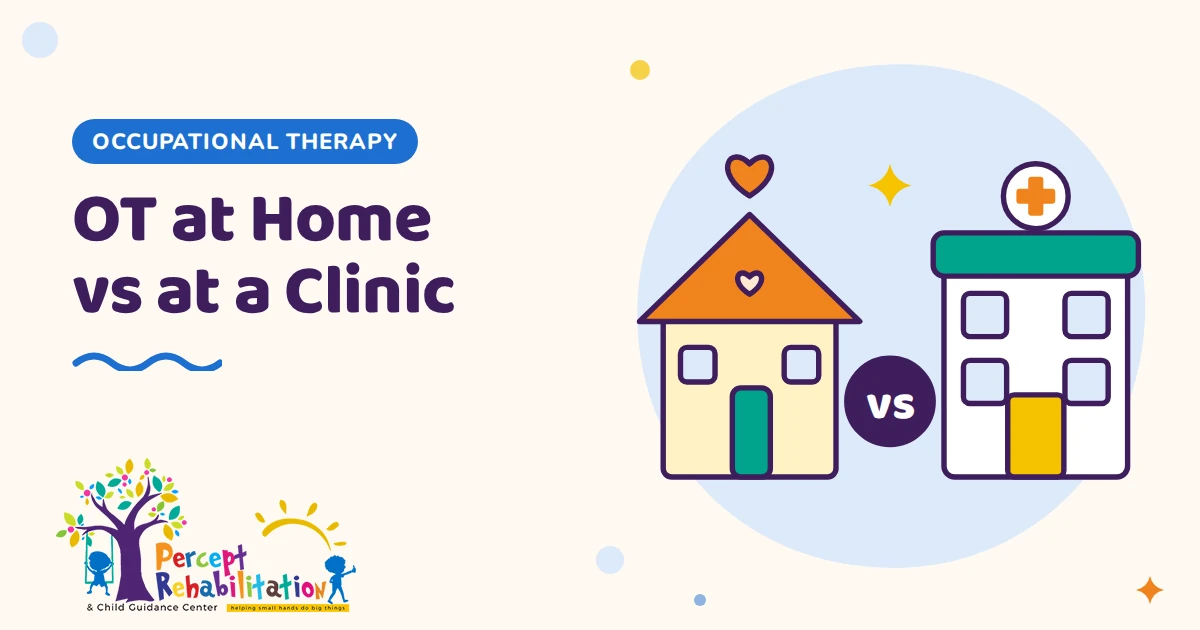
Home OT can work well for some children and some goals. For others, a clinic offers things a home simply can’t. Here’s an honest comparison to help you decide.
At a glance: home vs clinic OT
| Factor | Home OT | Clinic OT |
|---|---|---|
| Equipment | Limited to what the therapist carries | Full sensory gym, suspended swings, climbing and fine-motor stations |
| Best for | Self-care routines, home set-up, children who can’t travel | Sensory integration, motor planning, balance, most developmental goals |
| Travel | None for you | Two to three trips a week |
| Cost | Usually higher, due to therapist travel | Usually lower per session |
| Distractions | Siblings, TV, pets, familiar escape routes | Controlled, therapy-designed space |
| Social practice | Limited | Waiting-room and group therapy opportunities |
| Team access | Usually one therapist | Speech, ABA and other therapists on site |
When home occupational therapy makes sense
- Self-care goals. Practising dressing, toileting, bathing and mealtimes in the real environment where they happen.
- Home set-up advice. A therapist can suggest seating, routines and sensory-friendly changes in your actual home.
- Medical or mobility limits. Children who are medically fragile or can’t easily travel.
- Short-term transition. A few home sessions can help a very anxious child before moving to a clinic.
When clinic-based OT works better
- Sensory integration therapy. It relies on suspended equipment such as swings, bolster swings and platforms that give strong, controlled movement input. That equipment can’t be set up in a typical flat. Read what sensory integration therapy involves.
- Balance, coordination and motor planning. Climbing walls, ramps and obstacle courses build these skills far better than living-room floor space.
- Children who need several therapies. A multidisciplinary clinic lets your child’s OT and speech therapist coordinate goals.
- Focus. A therapy space removes the distractions that make home sessions harder.
The best of both: clinic sessions plus a home programme
For most children, the strongest approach is clinic-based therapy with a structured home programme. Your child gets specialised equipment and expertise at the clinic, and you practise targeted activities at home between sessions. Parent training ties the two together.
This is how progress continues across the whole week, not just during therapy hours.
Questions to ask before choosing home OT
- What equipment will the therapist bring?
- Can my child’s goals be met without a sensory gym?
- How does the fee compare with clinic sessions? Our guide to occupational therapy cost in Ghaziabad can help.
- How will progress be measured and reviewed?
- Can we move to clinic sessions later if needed?
How Percept approaches this
Most therapy at Percept takes place in our sensory gym in Indirapuram, because it gives children access to equipment and a team that home visits can’t. Every child also gets a home programme, and parents receive training so they can support progress between sessions.
[If home visits are offered: “We also offer home sessions for specific goals such as self-care routines, in [areas]. Ask us whether home, clinic or a mix is right for your child.”]
CTA: Visit our occupational therapy clinic in Indirapuram. Call +91 88604 60038 or message us on WhatsApp.
Frequently asked questions
Is home occupational therapy as effective as clinic therapy?
For self-care and home-routine goals, home OT can be very effective. For sensory integration, balance and motor planning, a clinic with specialised equipment usually works better.
Is occupational therapy at home more expensive?
Usually, yes, because the fee covers the therapist’s travel time. Clinic sessions typically cost less per session.
Can I do occupational therapy with my child at home myself?
You can and should practise the home programme your therapist gives you. It complements professional therapy but doesn’t replace assessment and specialist sessions.
My child hates new places. Should we start at home?
A few home sessions can help, but many anxious children settle into a clinic within two or three visits. A child-friendly sensory gym often feels like a playground to them.
Can my child switch between home and clinic sessions?
Often, yes. Some children start at home and move to the clinic, or combine both for different goals. Discuss this with your therapist.