If your child melts down at the sound of a hand dryer, refuses to wear certain clothes, crashes into furniture for fun, or simply can’t sit still, you’re not imagining it — and you’re not alone. These are often signs of a sensory processing challenge, and one of the most established ways to address it is sensory integration therapy.
This guide explains what sensory integration therapy is, how it works, which children it helps, and what to expect — written in plain language for parents who want answers, not jargon.
What Is Sensory Integration Therapy?
Sensory integration therapy is a play-based, occupational therapy approach that helps a child’s nervous system learn to receive, organize, and respond to sensory information more effectively.
The term covers everything from touch, sound, and sight to two senses most people have never heard of: the vestibular sense (balance and movement) and the proprioceptive sense (body awareness).
The approach was developed in the 1970s by occupational therapist Dr. A. Jean Ayres, which is why you’ll often see it called Ayres Sensory Integration (ASI). Ayres described it simply as “the organization of sensation for use” — how a child selects, sorts, and reacts to everything happening around them so they can function in daily life.
When this system works smoothly, a child can filter out a buzzing light and focus on a teacher. When it doesn’t, ordinary input can feel overwhelming, confusing, or not strong enough — and the result is the behaviour parents often describe as “meltdowns,” “clumsiness,” or “seeking trouble.”
Sensory Processing Disorder: The Challenge Behind the Behaviour
Many children who benefit from sensory integration therapy have what’s commonly called sensory processing disorder (SPD). It generally shows up in two patterns — and some children swing between both:
Over-responsive (hypersensitive)
These children are easily overwhelmed. Tags in clothing feel unbearable, food textures trigger gagging, loud or busy places cause distress, and unexpected touch can spark a big reaction.
Under-responsive or sensory-seeking (hyposensitive)
These children crave intense input. They crash, bump, spin, chew on objects, touch everything, and seem to never tire — because their nervous system needs more stimulation to register it.
Both patterns point to the same underlying issue: the brain isn’t processing sensory input in a balanced way. Sensory integration therapy — a core specialty at Percept Rehabilitation — is designed to gently retrain that process.
How Sensory Integration Therapy Works
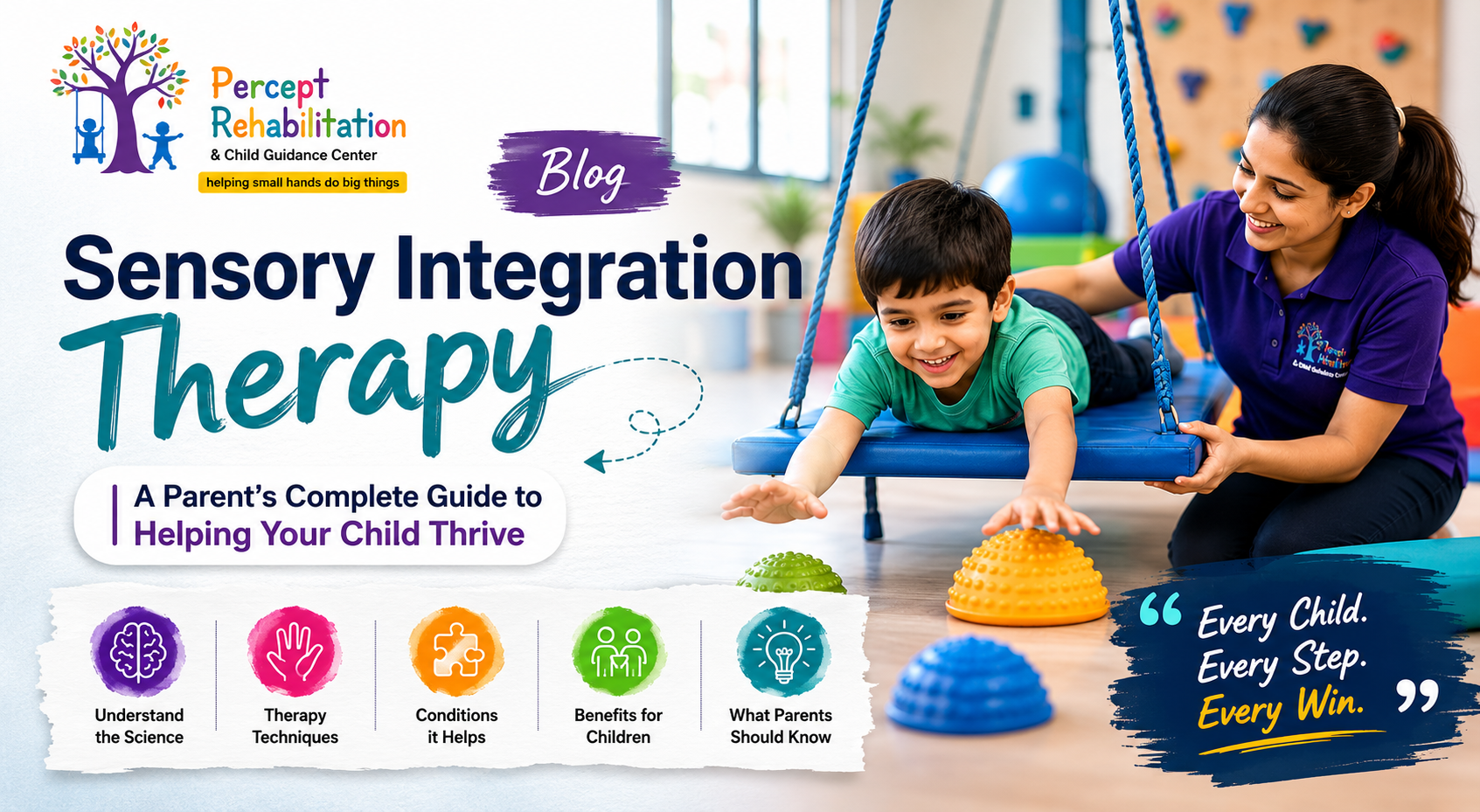
Walk into a sensory integration session and it can look more like a playground than a clinic — and that’s intentional. Therapy is delivered through carefully designed, child-led activities that challenge the nervous system just enough to build new, more organized responses.
A trained occupational therapist sets up activities using specialised equipment and techniques, including:
- Swings, hammocks, and spinning equipment to develop the vestibular (balance) system
- Trampolines, climbing walls, and obstacle courses for proprioceptive (body-awareness) input
- Deep-pressure activities, weighted vests, and brushing protocols to calm an over-reactive system
- Tactile play with textures, sand, and putty to build tolerance to touch
- Balance beams and motor-planning tasks to improve coordination (“praxis”)
The therapist continuously adjusts the “just-right challenge” — not too easy, not too hard — so the child stays engaged and the brain keeps adapting. Because it feels like play, children are motivated to participate, which is exactly what makes the learning stick.
What Is a Sensory Diet?
Alongside clinic sessions, therapists often create a sensory diet — a personalised set of sensory activities woven into a child’s daily routine at home and school.
Think of it as regular “nutrition” for the nervous system: movement breaks before homework, deep-pressure hugs before bed, or chewy snacks during focused work. A consistent sensory diet is often what turns short-term gains into lasting change.
Which Children Benefit From Sensory Integration Therapy?
Research and clinical experience show sensory integration therapy can help children across several conditions. It is most commonly used for:
Autism Spectrum Disorder
Sensory differences are extremely common in autism. Studies — including research highlighted by Autism Speaks — show that sensory integration therapy can improve daily functioning and reduce sensory-driven distress.
At Percept, our sensory integration work runs alongside ABA therapy and speech & language therapy for a fully integrated plan.
ADHD and Attention Challenges
Many children with ADHD also have sensory sensitivities. Addressing the sensory side often improves focus, self-regulation, and the ability to sit and complete tasks.
Sensory Processing Disorder
For children whose primary challenge is SPD itself, this therapy is the front-line approach — helping them tolerate everyday environments that once felt impossible.
Cerebral Palsy and Developmental Delays
Sensory integration therapy can support balance, coordination, and motor function in children with cerebral palsy and global developmental delays, often working hand-in-hand with physiotherapy.
Learning Difficulties
When sensory and motor foundations are shaky, learning suffers. Therapy supports the visual-motor and fine-motor skills behind handwriting and classroom participation, ideally aligned with special education goals.
Signs Your Child May Benefit
Consider an assessment if your child regularly shows several of the following:
- Strong reactions to sounds, lights, textures, or smells that don’t bother other children
- Constantly seeking movement — spinning, crashing, jumping, or chewing
- Difficulty with transitions, new environments, or changes in routine
- Clumsiness, poor balance, or trouble with coordination
- Avoiding messy play, certain foods, or specific clothing
- Struggles with handwriting, buttons, zippers, or other fine-motor tasks
The Benefits of Sensory Integration Therapy
With consistent, individualised therapy, families commonly report meaningful improvements within a few months, including:
- Better focus and attention at home and in school
- Calmer responses to everyday sensory input and fewer meltdowns
- Improved balance, coordination, and gross- and fine-motor skills
- Greater independence in dressing, eating, and self-care
- Stronger social engagement and emotional regulation
What to Expect at Percept Rehabilitation
If you’re searching for sensory integration therapy near Noida or Ghaziabad, here’s how the process typically unfolds with our team:
- Initial consultation — a conversation about your child’s challenges, history, and daily routine
- Sensory assessment — a structured evaluation of how your child processes movement, touch, and other input
- Individualised plan — therapy goals and a home sensory diet built around your specific child, not a template
- Ongoing sessions with reviews — regular therapy plus parent guidance, because progress at home matters as much as in the clinic
Why Early Intervention Matters
A young child’s brain is remarkably adaptable, which is why earlier therapy tends to bring greater progress.
If something feels “off” about your child’s development — even if you can’t quite name it — an assessment is worthwhile.
Our early intervention program supports children from 18 months onward, and many parents tell us they wish they’d started sooner.
Sensory Integration Therapy Near Noida & Ghaziabad
Percept Rehabilitation Center is located in Indirapuram, Ghaziabad — minutes from the Noida sectors and easily reached from across the NCR.
Our multidisciplinary team brings occupational therapy, sensory integration, speech therapy, ABA therapy, and group therapy together under one roof — meaning coordinated, consistent care instead of appointments scattered across the city.
Book an appointment today or call us at +91 88604 60038.
Frequently Asked Questions
How long does sensory integration therapy take to work?
Every child is different, but many families notice meaningful change within three to six months of consistent therapy combined with a home sensory diet.
Is sensory integration therapy the same as occupational therapy?
Sensory integration is a specialised approach delivered within occupational therapy. A trained occupational therapist provides it as part of a broader plan.
What age is best to start?
Earlier is generally better because young brains adapt fastest, but children of many ages can benefit. At Percept we support children from 18 months onward.
Not sure if sensory integration therapy is the right next step? Reach out to our team — we’re happy to help you figure out what your child needs.