The phrase “occupational therapist” confuses a lot of people. It sounds like it’s about jobs and careers — but it isn’t. Occupational therapy is about helping someone do the everyday “occupations” that fill their life: a child learning to hold a pencil, an adult relearning to dress after a stroke, an older person staying safe and independent at home.
Whether you’re a parent worried about your child’s development or a family caring for an ageing relative, this guide explains exactly what an occupational therapist does, who they help, and how occupational therapy differs for children and adults.
What Is an Occupational Therapist?
An occupational therapist (OT) is a trained health professional who helps people of all ages take part in the daily activities that matter to them.
Rather than focusing on a single symptom, an occupational therapist looks at the whole person — their physical ability, sensory system, thinking skills, emotions, and environment — and removes the barriers getting in the way of everyday life.
Those everyday activities, or “occupations,” look different at every age. For a child they include playing, learning, dressing, and making friends. For an adult they include working, cooking, driving, self-care, and living independently. The job of an occupational therapist is to help each person do these things as fully and safely as possible.
What Does an Occupational Therapist Do?
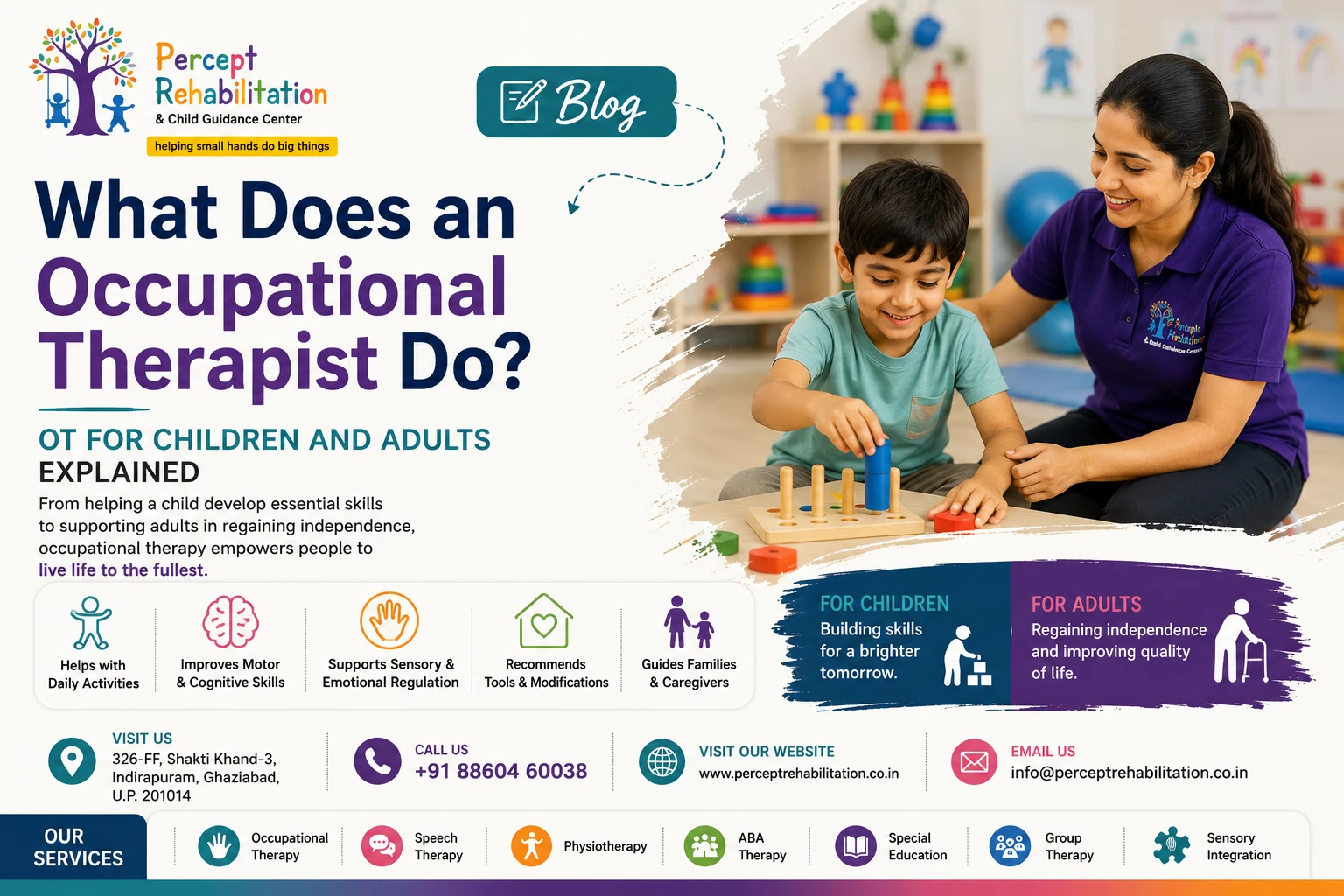
A typical occupational therapist’s work involves a blend of assessment, hands-on therapy, and practical problem-solving. Day to day, an OT may:
- Assess how a person manages daily tasks and where they struggle
- Build fine-motor and gross-motor skills — grip, coordination, balance, strength
- Support sensory processing and emotional regulation through sensory integration therapy
- Improve memory, attention, planning, and other cognitive skills
- Recommend adaptive tools, equipment, and home or classroom modifications
- Coach families and caregivers so progress continues outside the clinic
Crucially, an occupational therapist never uses a one-size-fits-all programme. Every plan is built around the individual’s goals — which is exactly what makes OT so effective.
Occupational Therapy for Children vs Adults: The Key Difference
The single biggest difference comes down to one idea: habilitation versus rehabilitation. Paediatric occupational therapy is usually about building skills for the first time, while adult occupational therapy is more often about recovering skills that were lost to injury, illness, or ageing.
Paediatric Occupational Therapy (Children)
A paediatric occupational therapist helps children reach developmental milestones and build the foundations for learning, play, and social life — skills they haven’t developed yet.
Because it must address the physical, cognitive, social, and sensory sides of a growing child all at once, paediatric OT is often more complex than adult therapy. Most of this work happens through play, which keeps children motivated and engaged.
Occupational therapists commonly help children with:
- Autism Spectrum Disorder and sensory processing difficulties
- ADHD and attention or executive-function challenges
- Developmental delays and cerebral palsy
- Learning difficulties such as dyslexia and dysgraphia
- Fine-motor problems affecting handwriting, buttons, and self-care
At Percept, paediatric OT works closely with our sensory integration therapy, ABA therapy, and speech & language therapy teams so each child gets one coordinated plan rather than disconnected sessions.
Adult & Geriatric Occupational Therapy
For adults, an occupational therapist focuses on regaining or maintaining independence. This might mean relearning daily tasks after a stroke or injury, managing a long-term condition, preventing falls, or adapting a home so it stays safe and accessible.
Therapy goals centre on work, self-care, and living independently.
Occupational therapists commonly support adults with:
- Stroke recovery and neurological conditions
- Orthopaedic injuries and post-surgery rehabilitation
- Arthritis and other chronic pain conditions
- Age-related challenges, including dementia and fall prevention
- Hand therapy and return-to-work rehabilitation
For adults with motor or mobility challenges, OT often works alongside physiotherapy, since the two disciplines complement each other well.
When Should You See an Occupational Therapist?
It’s worth seeking an assessment for a child who:
- Is behind on milestones, or struggles with handwriting, dressing, or coordination
- Has strong reactions to sounds, textures, or busy environments
- Finds it hard to focus, follow instructions, or manage transitions
And for an adult who:
- Is recovering from a stroke, surgery, or injury
- Finds everyday tasks harder due to pain, weakness, or ageing
- Needs support to stay safe and independent at home or work
Why Timing Matters
With children, earlier is almost always better — a young brain is at its most adaptable, so therapy started sooner tends to bring greater progress.
Our Early Intervention Program supports children from 18 months onward.
For adults, starting OT promptly after an injury or diagnosis can speed recovery and prevent secondary complications.
In both cases, the message is the same: don’t wait for things to get worse before getting an assessment.
What to Expect From Your First OT Session
If you’re searching for an occupational therapist near Noida or Ghaziabad, here’s how the process typically works at Percept:
- Initial consultation — a conversation about the challenges, history, and daily routine
- Standardised assessment — a structured evaluation of motor skills, sensory processing, and functional abilities
- Individualised treatment plan — goals built around the specific person, not a generic template
- Ongoing sessions with reviews — regular therapy, progress tracking, and built-in family guidance
For children, we also align therapy with school strategies through our special education team, and use group therapy to build social skills where helpful.
Finding an Occupational Therapist Near Noida & Ghaziabad
Percept Rehabilitation Center is located in Indirapuram, Ghaziabad — minutes from the Noida sectors and easily reached from across the NCR.
Our multidisciplinary team of occupational therapists and specialists works together under one roof, so you get coordinated, consistent care instead of appointments scattered across the city — whether the therapy is for a child or an adult.
Book an appointment today or call us at +91 88604 60038.
Frequently Asked Questions
What is the difference between an occupational therapist and a physiotherapist?
A physiotherapist focuses mainly on movement, strength, and physical function, while an occupational therapist focuses on helping you perform meaningful daily activities — though the two often work together.
Do occupational therapists only work with children?
No. Occupational therapists help people of all ages, from infants reaching milestones to older adults staying independent at home.
How do I know if my child needs an occupational therapist?
If your child is behind on milestones, struggles with handwriting or self-care, or has strong sensory reactions, an OT assessment can clarify whether therapy would help.
Contact Percept Rehabilitation & Child Guidance Center
Address: 326-FF, ShaktiKhand-3, Indirapuram, Ghaziabad
Phone: +91 88604 60038
Email: info@perceptrehabilitation.co.in
Not sure if occupational therapy is the right next step? Reach out to our team — we’re happy to help you figure out what you or your child needs.