Parenting is a journey filled with profound joy, but when a child is diagnosed with a developmental delay or an Autism Spectrum Disorder (ASD), it can also introduce a complex maze of medical terms, therapies, and decisions. If you are navigating this path, you are not alone. Across India and right here in Ghaziabad, countless families are seeking the right interventions to help their children unlock their full potential.
At Percept Rehabilitation Center, located in the heart of Indirapuram, Ghaziabad, we believe that every child deserves to be respected, loved, and given the tools to thrive. Finding the best pediatric therapy center in Indirapuram, Ghaziabad, doesn’t have to be overwhelming.
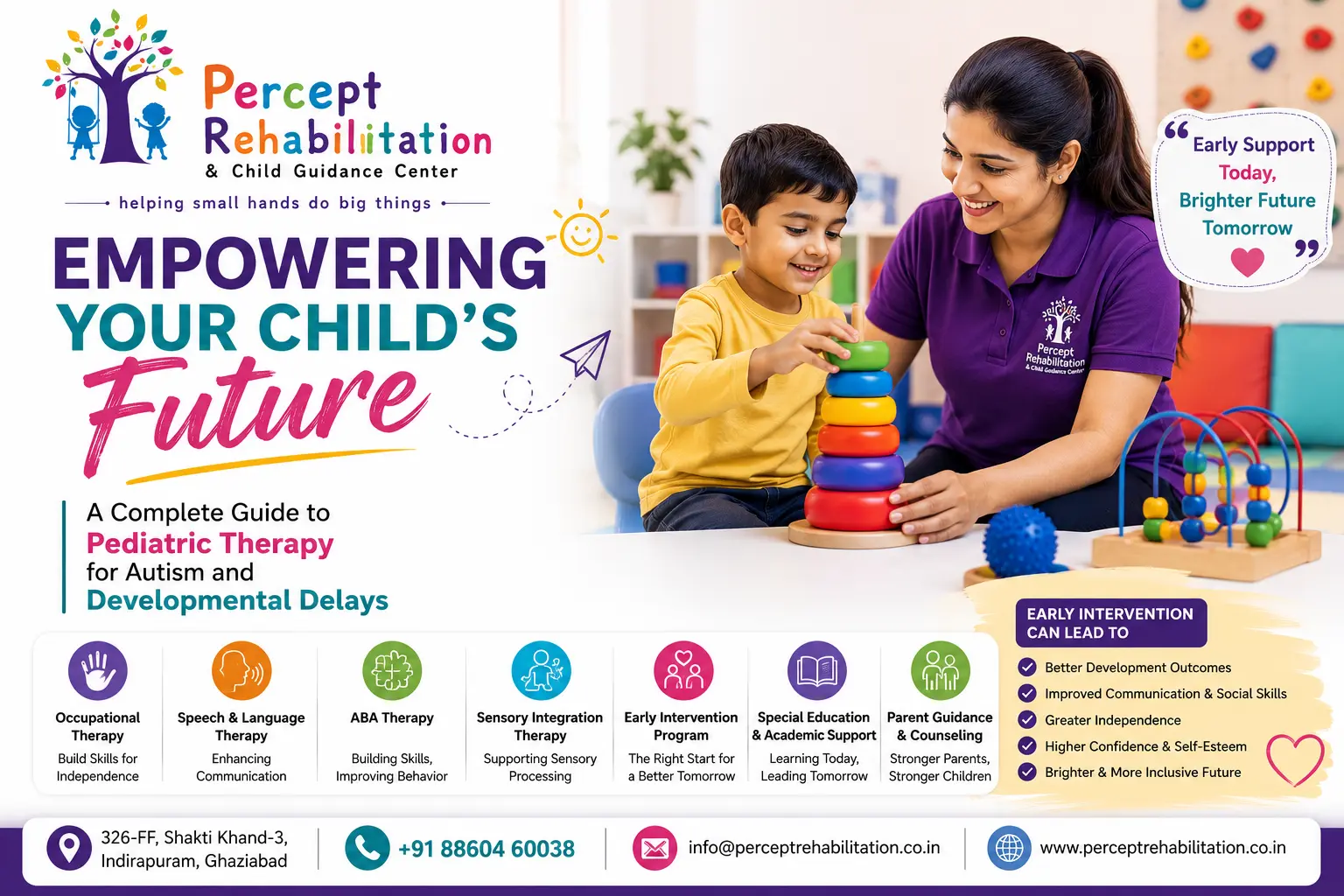
This comprehensive guide will walk you through the realities of developmental delays, the transformative power of early intervention, and how therapies like Occupational Therapy, Speech Therapy, and Applied Behavior Analysis (ABA) can dramatically shape your child’s future.
Understanding the Landscape: Autism and Developmental Delays in India
A developmental delay occurs when a child does not reach their developmental milestones at the expected times. These delays can occur in motor skills, speech and language, cognitive abilities, or social and emotional development. In many cases, these delays are the earliest indicators of neurodevelopmental conditions like Autism Spectrum Disorder (ASD), Sensory Processing Disorder, or ADHD.
The Statistical Reality of Autism
Understanding the scope of autism helps remove the stigma and highlights the urgent need for accessible therapy. While large-scale, standardized studies in India are continually evolving, current epidemiological data paints a clear picture:
- Prevalence: It is estimated that roughly 1% to 1.5% of children in India are on the autism spectrum. This translates to about 1 in every 68 to 100 children.
- National Impact: Nationally, this suggests that over 1.8 to 2 million children are affected by ASD in India alone.
- Gender Disparities: Consistent with global trends, boys in India are diagnosed more frequently than girls, at a ratio of approximately 3:1.
- Rising Identification: Diagnosis rates are increasing globally and locally. In the early 2000s, autism in India was thought to affect only 1 in 1,000 children. Today’s figures (closer to 1 in 68) do not necessarily mean the condition is spreading; rather, it reflects drastically improved awareness, better diagnostic tools, and a reduction in social stigma.
Behind every statistic is a child with unique strengths, challenges, and an immense capacity for growth. The key to unlocking that growth lies in identifying the signs early.
Recognizing the Early Signs of Developmental Delays
The timeline of child development is a spectrum, but significant deviations warrant professional assessment. Early identification is the crucial first step toward effective treatment. Here are common red flags parents should look out for:
By 6 to 12 Months
- Lack of warm, joyful expressions or smiles by 6 months.
- No back-and-forth sharing of sounds, smiles, or other facial expressions by 9 months.
- No babbling or lack of response to their name by 12 months.
- No back-and-forth gestures, such as pointing, showing, reaching, or waving by 12 months.
By 16 to 24 Months
- No single spoken words by 16 months.
- No meaningful two-word phrases (excluding imitating or repeating) by 24 months.
- Loss of previously acquired speech, babbling, or social skills at any age.
- Intense sensory seeking or sensory avoidance (e.g., covering ears at normal household sounds, refusing certain clothing textures).
If you notice these signs, a “wait-and-see” approach is heavily discouraged by pediatricians worldwide. Seeking an assessment at a specialized center is the best proactive step you can take.
The Science of Early Intervention: Why Timing is Everything
When parents ask, “Does therapy really make a difference?” the scientific community responds with a resounding yes—especially when intervention begins early.
During the first three years of life, a child’s brain is in a state of rapid development, forming over 1,000 neural connections per second. This phenomenon, known as neuroplasticity, makes the brain incredibly responsive to therapeutic interventions. It can literally reshape how a child moves, thinks, and interacts with their world.
The Data Behind Early Intervention Success
Recent clinical trials and neurological studies provide staggering proof of how effective early pediatric therapy can be:
- Accelerated Milestone Achievement: Research demonstrates that children who receive targeted occupational and behavioral therapy before the age of three achieve developmental milestones 75% faster than those who begin therapy after age five.
- Dramatic Cognitive and Language Improvements: A recent clinical trial focusing on early intervention initiated at 18 months showed remarkable results. Children who received preemptive, intensive intervention demonstrated an average IQ increase of 15 to 18 points compared to those receiving standard care. Furthermore, receptive language scores improved nearly twice as much in the early intervention group.
- Altering the Diagnostic Trajectory: In some groundbreaking studies, early intervention altered the trajectory of autism symptoms so significantly that by age 3, a notable percentage of high-risk infants in the intervention group no longer met the full diagnostic criteria for severe ASD, shifting to much milder classifications.
- Long-Term Economic Value: Economic analyses reveal that early intervention is not just clinically effective, but financially sound. Every dollar invested in early pediatric occupational therapy saves an average of $7 in future educational, healthcare, and supportive care costs by preventing the compounding effects of untreated delays.
At Percept Rehabilitation Center, our Early Intervention programs are designed to capitalize on this critical neuroplastic window, giving your child the strongest possible foundation for the future.
Core Pediatric Therapies: Building Blocks for Success
No two children are exactly alike, which is why a “one-size-fits-all” approach to therapy inevitably fails. Comprehensive rehabilitation requires a multidisciplinary approach. Here is a deep dive into the core services that make up a robust pediatric therapy plan.
- Pediatric Occupational Therapy (OT)
When adults hear “occupational therapy,” they often think of job rehabilitation. For a child, their “occupation” is playing, learning, and developing life skills.
Occupational therapy at Percept often mimics play. Through therapeutic play, children learn how to manage themselves, organize their bodies, plan actions, and solve problems. If you are searching for the best occupational therapy in Ghaziabad, our center focuses on:
- Fine Motor Skills: Developing the coordination required for holding a pencil, using scissors, buttoning a shirt, or tying shoelaces.
- Gross Motor Skills: Improving balance, core strength, and bilateral coordination (using both sides of the body together).
- Activities of Daily Living (ADLs): Fostering independence in grooming, feeding, and dressing.
- Sensory Integration Therapy
Sensory Integrative Disorder (often co-occurring with Autism) happens when the brain has trouble receiving and responding to information that comes in through the senses. A child might be overly sensitive to lights, sounds, and textures (sensory avoiding), or they might constantly crave intense movement and deep pressure (sensory seeking).
Sensory Integration therapy is a specialized form of occupational therapy. At Percept, our sensory gyms are equipped with specialized swings, trampolines, tactile bins, and crash pads. Therapists guide children through activities that gently challenge their sensory processing capabilities, helping their nervous systems become more regulated and adaptable to everyday environments.
- Speech & Language Therapy
Communication is a fundamental human need. Children with developmental delays often struggle with expressive language (putting words together to express thoughts) or receptive language (understanding what others are saying).
Our targeted speech therapy for kids addresses:
- Articulation Disorders: Helping children pronounce sounds correctly so they can be easily understood.
- Fluency: Addressing stuttering or pacing issues.
- Pragmatic (Social) Language: Teaching the unspoken rules of conversation, such as making eye contact, taking turns, and understanding non-verbal cues.
- Non-Verbal Communication: For children who are pre-verbal, therapists introduce Augmentative and Alternative Communication (AAC) devices or sign language to give them a voice immediately.
- Applied Behavior Analysis (ABA) Therapy
ABA therapy is widely recognized as the gold standard treatment for Autism Spectrum Disorder. It is a highly structured, evidence-based approach that focuses on improving specific behaviors—such as social skills, communication, and academics—while simultaneously reducing behaviors that may interfere with learning or be harmful.
At Percept, we personalize our ABA services. We move away from rigid, outdated models and embrace a compassionate, play-based approach to ABA that respects the child’s autonomy while gently encouraging positive behavioral milestones.
- Specialized Support Therapies
Comprehensive care often requires looking beyond the primary therapies. We also offer:
- Special Education: Tailored educational plans that accommodate a child’s unique learning style, especially vital for children with Learning Disabilities.
- Oral Intervention & Feeding Therapy: Helping children who have physical difficulties chewing/swallowing or extreme sensory aversions to the textures and tastes of food.
- Physiotherapy: Addressing broader musculoskeletal issues, muscle tone abnormalities, and postural control.
- Yoga & Group Therapies: Fostering mindfulness, emotional regulation, and vital peer-to-peer social skills in a safe, moderated environment.
The Secret Ingredient to Therapy Success: Parent Participation
A clinic is a controlled environment, but real life happens at home, at the grocery store, and on the playground. One of the most significant shifts in modern pediatric therapy is the realization that parents are not just observers—they are the most vital members of the therapy team.
The Statistics on Parental Involvement
Clinical data strongly underscores the necessity of parent involvement. A landmark study evaluating the effectiveness of parent participation in occupational therapy for children with developmental delays revealed a striking statistic: Children whose parents actively participated in their occupational therapy programs made progress at a rate 1.89 times greater (nearly double) than children who received therapist-only intervention.
When parents are trained to carry over therapeutic strategies into daily routines, the child receives continuous, gentle intervention throughout their day, rather than just during a 45-minute clinic session.
How Percept Empowers Parents
At Percept Rehabilitation Center, our treatment plans actively involve and educate parents. We do not just treat your child behind closed doors; we invite you into the process.
- Individualized Planning: We develop customized treatment plans with direct input from families.
- Digital Access: We offer a dedicated Patient/Parent Login portal on our website, allowing you to seamlessly book appointments, review therapist notes, and stay connected to your child’s progress.
- Home Programs: We provide actionable, simple strategies you can use at home to reinforce what was learned in the clinic.
Why Choose Percept Rehabilitation Center in Indirapuram, Ghaziabad?
Finding an Autism therapy center in Ghaziabad that aligns with your family’s values and clinical needs is a major decision. Here is how Percept sets itself apart from the competition:
- Elite Clinical Standards: Quicker access to superior clinical care is our hallmark. All of our therapists are Board Certified and licensed. Furthermore, our therapists’ training duration and continuing education requirements exceed industry standards by up to four times.
- A Holistic Vision: Our vision extends beyond the clinic walls. We want to teach children lifelong skills they can utilize in their future endeavors—socially, emotionally, and physically.
- State-of-the-Art Facility: Located conveniently at 326-FF, Shakti Khand-3, Indirapuram, Ghaziabad, our center is designed to be a safe, welcoming, and highly stimulating environment for children of all abilities.
- Core Values of Respect: We firmly believe that kids ought to be respected and loved first and foremost. We value every child and embrace the opinions, comments, and recommendations of the family.
Take the First Step Toward Your Child’s Potential
Navigating a developmental delay or an autism diagnosis can be challenging, but with the right team by your side, it is also a journey filled with incredible victories and breakthroughs. Whether your child needs help holding a pencil, speaking their first sentence, or regulating their sensory environment, the dedicated team at Percept is here to guide them.
Do not wait to seek help. The window for early intervention is open right now, and every day is an opportunity for growth.
Ready to help your child realize their full potential?
- Book an Appointment Online: Use our convenient online booking portal at https://www.perceptrehabilitation.co.in/
- Call Us: +91 88604 60038
- Email Us: info@perceptrehabilitation.co.in
- Visit Us: 326-FF, Shakti Khand-3, Indirapuram, Ghaziabad (Open MON – SAT: 09:00 AM – 08:00 PM)
Partner with the best pediatric therapy center in Indirapuram, Ghaziabad today, and let’s build a brighter, more independent tomorrow for your child.