Most parents have heard the term “occupational therapy” — usually from a doctor’s referral, a school assessment, or a worried conversation with another parent. But what exactly does OT occupational therapy involve? And more importantly, how do you know if your child actually needs it? If you’ve been searching for a occupational therapist near me or OT near me and aren’t quite sure what to expect, this post will walk you through the conditions that occupational therapy commonly addresses — in plain, honest language.
What Is Occupational Therapy, Really?
Occupational therapy (or OT) helps people of all ages participate in meaningful daily activities — things like dressing, eating, writing, playing, and socializing. For children, those “occupations” include going to school, making friends, and learning new skills.
An occupational therapist doesn’t just work on one skill in isolation. They look at the whole child — their sensory system, motor control, emotional regulation, and cognitive abilities — and figure out what’s getting in the way of everyday functioning.
OT isn’t a one-size-fits-all approach. That’s what makes it genuinely effective.
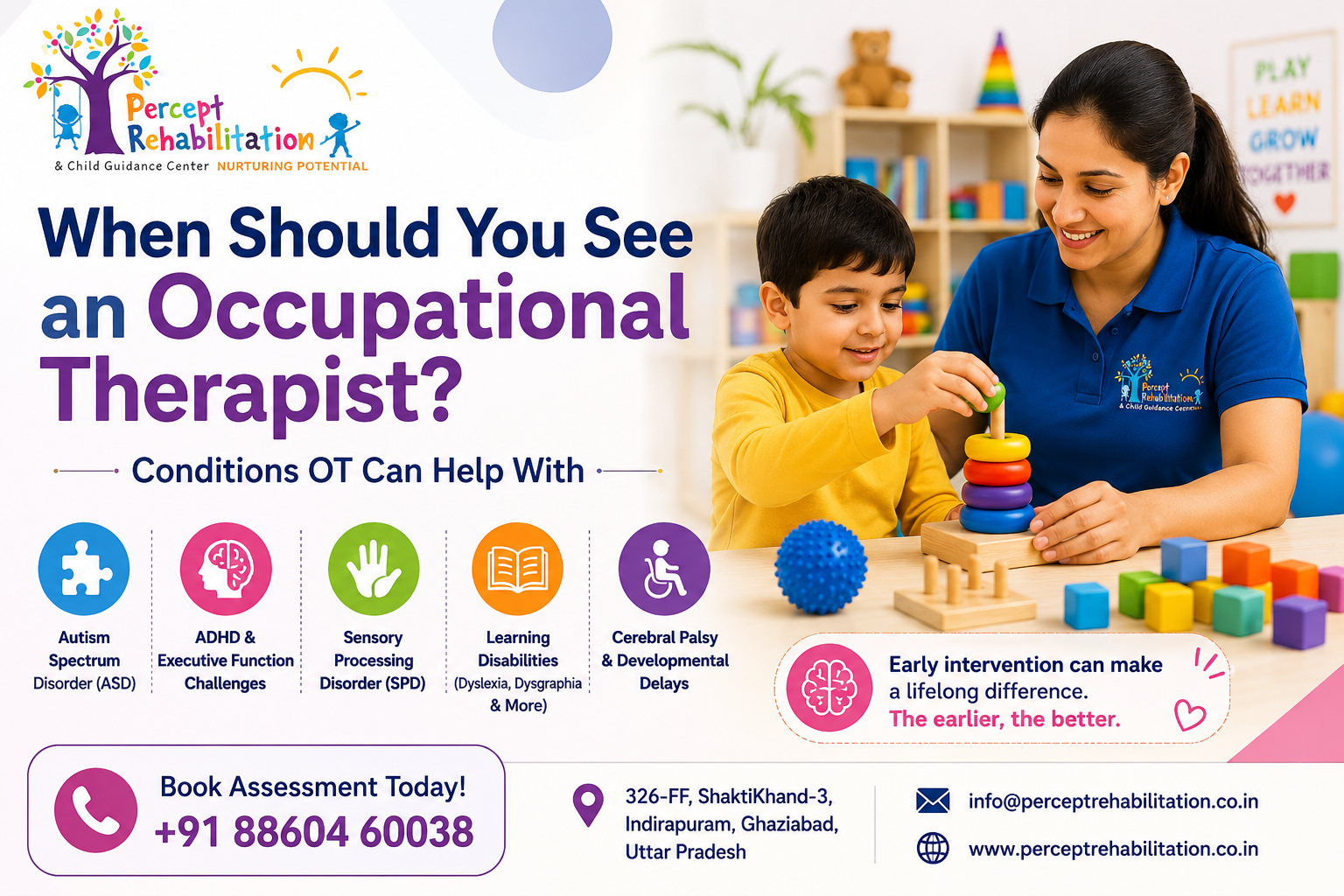
5 Conditions Where Occupational Therapy Makes a Real Difference
1. Autism Spectrum Disorder (ASD)
This is probably the most common reason families seek out occupational therapy near Noida and across the NCR region. Children with autism often struggle with sensory processing, social interaction, self-care routines, and emotional regulation — all areas where OT can have a significant, lasting impact.
At Percept Rehabilitation, our occupational therapists work alongside our ABA therapy and speech & language therapy teams to build integrated treatment plans specific to each child’s profile. There’s no generic program here — every plan is built around the individual.
Signs your child may benefit from OT:
- Difficulty tolerating clothing textures, food, or loud sounds
- Meltdowns during transitions or routine changes
- Trouble with handwriting, buttons, or zippers
- Challenges making eye contact or engaging with peers
2. Sensory Processing Disorder (SPD)
Some children are hypersensitive — they overreact to sensory input like touch, noise, or bright light. Others are hyposensitive — they constantly seek intense sensory experiences, like crashing into furniture, chewing objects, or spinning. Both patterns point to a sensory processing challenge.
Sensory integration therapy — a core specialty at Percept — helps the nervous system learn to process and respond to sensory input more appropriately. Through carefully designed activities (often disguised as play), children gradually build better self-regulation and tolerance.
This is one of those conditions where parents tend to notice meaningful progress within a few months of consistent occu therapy — especially when home strategies are woven in alongside clinic sessions.
3. Learning Disabilities — Dyslexia, Dysgraphia & More
When a child struggles in school despite obvious intelligence and real effort, a learning disability is often at the root. OT occupational therapy doesn’t replace academic tutoring, but it addresses the underlying developmental gaps that make learning harder — things like fine motor control, visual-motor integration, and executive functioning.
A child with dysgraphia, for example, may avoid writing tasks entirely because of how physically painful or frustrating they find them. An occupational therapist can work on grip, posture, pencil pressure, and even how the child organizes thoughts on paper.
At Percept, we also connect families with our special education team so that school strategies and therapy goals stay aligned — a gap that’s unfortunately common when different professionals work in silos.
4. Cerebral Palsy and Developmental Delays
Children with cerebral palsy or global developmental delays often face significant challenges with motor coordination, self-care, and functional independence. Occupational therapy helps them build the physical and cognitive skills needed to participate in daily life as fully as possible.
This isn’t about “fixing” a child — it’s about maximizing their potential within their own unique abilities. At Percept, our physiotherapy and OT teams often collaborate closely for children with motor challenges, because the two disciplines complement each other in meaningful ways.
5. ADHD and Executive Function Challenges
ADHD isn’t just about attention — it’s about the ability to plan, initiate, organize, and regulate behavior. Children with ADHD frequently struggle with following multi-step instructions, managing time, staying organized, and controlling impulses.
OT helps children develop practical strategies for these executive function challenges. Therapists also evaluate sensory processing because, more often than not, sensory sensitivities and ADHD co-occur — and addressing both leads to significantly better outcomes than treating either in isolation.
Early Intervention: Why Timing Matters
One thing nearly every occupational therapist agrees on — earlier is better. A child’s brain is most adaptable in the first few years of life. The earlier therapy begins, the more progress is typically possible.
If you’ve noticed something “off” with your child’s development — even if you can’t quite put a finger on it — it’s worth getting an assessment. Our early intervention program at Percept is designed for children from 18 months onward, and many families tell us they wish they’d come in sooner.
What to Expect From Your First OT Session
If you’re looking for an occupational therapist near me in the Noida or Ghaziabad area, here’s how the process at Percept typically unfolds:
- Initial consultation — A conversation about your child’s challenges, history, and daily routine
- Standardized assessment — A structured evaluation of sensory processing, motor skills, and functional abilities
- Individualized treatment plan — Goals built around your child’s specific needs, not a generic template
- Ongoing sessions — Regular therapy with progress reviews and built-in parent guidance
Parents are active participants in our process — not just observers. We believe therapy doesn’t end at the clinic door, and that what happens at home matters just as much as what happens in a session.
Finding Occupational Therapy Near Noida — We’re Closer Than You Think
Percept Rehabilitation Center is located in Indirapuram, Ghaziabad — just minutes from Noida sectors and easily accessible from across the NCR. If you’ve been searching for occupational therapy near Noida or OT near me, we’d love to connect with you.
Our multidisciplinary team — specialists in OT, sensory integration, speech therapy, ABA, group therapy, and more — works together under one roof. Fewer appointments scattered across the city, more coordinated care for your child.
Ready to take the next step? Book an appointment today or call us at +91 88604 60038
Not sure if OT is the right next step? Reach out to our team — we’re happy to help you figure out what your child needs.