Occupational therapy and physiotherapy are often confused, and it’s easy to see why. Both help people move and function better, both are common after injury or illness, and many children see both.
But they have different goals. Here’s how occupational therapy vs physiotherapy compares, and how to know which one you or your child needs.
The short answer
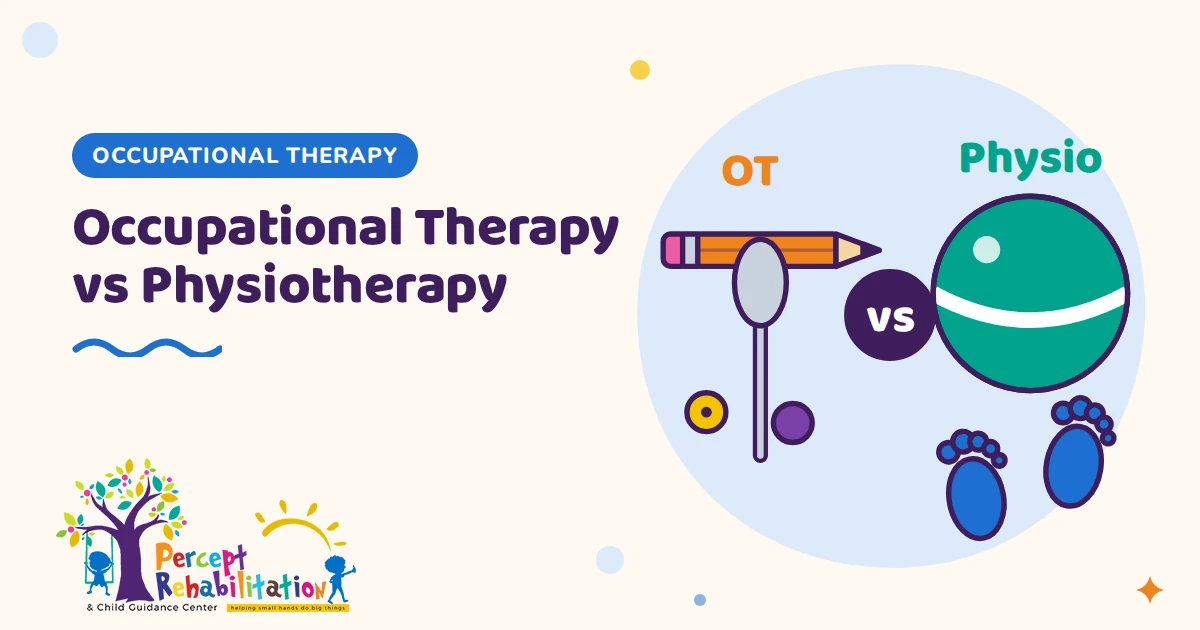
Physiotherapy helps you move better. It focuses on strength, flexibility, mobility, balance and pain.
Occupational therapy helps you do the things you need and want to do. It focuses on everyday activities, the “occupations” of life, such as dressing, eating, writing, playing, working and managing emotions.
A physiotherapist might help a child strengthen their legs to walk. An occupational therapist might help that same child climb stairs at school, get dressed independently or hold a pencil. Learn more in what does an occupational therapist do?
Side-by-side comparison
| Occupational therapy | Physiotherapy | |
|---|---|---|
| Main goal | Independence in daily activities | Movement, strength and mobility |
| Typical focus in children | Fine motor skills, self-care, sensory processing, handwriting, attention, play | Gross motor skills, walking, posture, muscle tone, balance |
| Typical focus in adults | Returning to self-care, work and home tasks after stroke, injury or illness | Recovering movement and reducing pain after injury, surgery or stroke |
| Common tools | Sensory gym, fine motor tasks, adaptive equipment, home and school strategies | Exercise, stretching, manual therapy, electrotherapy, gait training |
| Looks at | The person, the task and the environment | The body’s movement systems |
| Degree in India | BOT / MOT | BPT / MPT |
When a child needs occupational therapy
- Struggles with fine motor skills like holding a pencil, using scissors or buttoning.
- Has sensory sensitivities, such as reactions to noise, textures or touch.
- Finds self-care difficult: dressing, eating or toileting.
- Has trouble with attention, organisation or emotional regulation.
- Has handwriting that is slow, messy or painful.
See our full age-by-age signs your child needs occupational therapy.
When a child needs physiotherapy
- Delayed sitting, crawling or walking.
- Low or high muscle tone affecting movement.
- Recovery after a fracture, surgery or injury.
- Conditions like cerebral palsy affecting posture and mobility.
- Persistent toe walking with tight calves.
When both work best together
Many children benefit from both. A child with cerebral palsy, developmental delay or coordination difficulties may see a physiotherapist to build strength and walking, and an OT to turn those gains into independence in dressing, eating and play. In a multidisciplinary centre, the two therapists can share goals and avoid overlap.
Occupational therapy and physiotherapy for adults
After a stroke, for example, a physiotherapist helps restore movement in the arm and leg, while an occupational therapist helps the person relearn how to dress, cook and return to daily life. Both are essential parts of rehabilitation.
How to choose
Ask yourself: is the main problem how the body moves, or how the person manages daily tasks? If you’re unsure, an assessment will clarify it. A good therapist will refer you to the other discipline if that’s what you need.
OT and physiotherapy at Percept
Percept Rehabilitation Center in Indirapuram offers both occupational therapy and physiotherapy under one roof, so your child’s therapists can work towards shared goals. Every plan starts with an assessment, and we’ll tell you honestly which therapy, or combination, will help most.
CTA: Book an assessment for occupational therapy in Indirapuram. Call +91 88604 60038 or message us on WhatsApp.
Frequently asked questions
Is occupational therapy the same as physiotherapy?
No. Physiotherapy focuses on movement and physical function, while occupational therapy focuses on everyday activities and independence.
Which is better for my child, OT or physiotherapy?
It depends on your child’s needs. OT is usually better for fine motor, sensory and self-care difficulties. Physiotherapy is usually better for walking, strength and mobility.
Can my child have OT and physiotherapy at the same time?
Yes. Many children benefit from both, especially when the therapists coordinate their goals.
Do occupational therapists do exercises?
Sometimes, but exercises are always linked to a functional goal, such as strengthening hands for writing or building core stability for sitting at school.
Is occupational therapy only for children?
No. OT helps people of all ages, from premature babies to older adults recovering from stroke or managing daily life at home.